
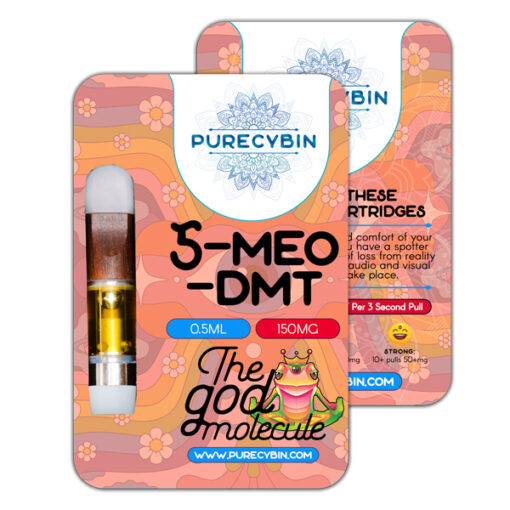
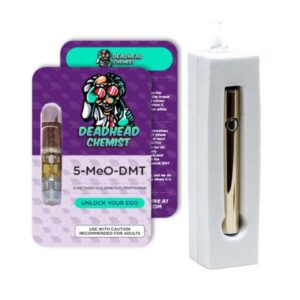
Purecybin 5-MeO-DMT Vape Cartridge – 150mg DMT
$100.00
Dosage Guidance
Take one moderate draw (10–15mg equivalent) while seated or lying down in a safe, controlled setting. Users new to 5-MeO-DMT are advised to have a sober guide or trip sitter present due to the intensity and rapid onset.
Important: 5-MeO-DMT is not recreational. It should only be used with intention, preparation, and post-experience integration.
5-MeO-DMT: An Educational Overview of a Potent Tryptamine Compound
5-MeO-DMT (5-Methoxy-N,N-Dimethyltryptamine) is a naturally occurring psychedelic compound belonging to the tryptamine family. It has gained attention in scientific, psychological, and anthropological research due to its powerful effects on perception and consciousness. While interest in the compound has increased in recent years, it remains a controlled substance in many countries, and research is highly regulated.
What Is 5-MeO-DMT?
5-MeO-DMT is a psychoactive compound structurally related to DMT and other tryptamines. It interacts with serotonin receptors in the brain, which are involved in regulating mood, perception, cognition, and sensory processing.
Unlike some other psychedelic compounds, 5-MeO-DMT is known for producing very intense and short-lived alterations in consciousness in research and anecdotal reports. However, scientific understanding of its full effects is still developing.
Natural Sources
5-MeO-DMT has been identified in certain plant species and also in the secretions of some amphibians, most notably the Colorado River toad (Incilius alvarius). The presence of this compound in both plant and animal sources has made it an interesting subject for biochemical and evolutionary research.
Researchers continue to investigate why this compound exists in nature and what biological roles it may serve.
Chemical Classification
5-MeO-DMT belongs to the tryptamine class of compounds. Tryptamines are a broad family of molecules that share a common chemical structure and are found throughout nature.
This class includes both naturally occurring neurotransmitters, such as serotonin, and various psychoactive compounds studied in neuroscience and pharmacology.
How It Interacts With the Brain
Scientific studies suggest that 5-MeO-DMT primarily affects serotonin receptor systems, particularly the 5-HT2A receptor and related pathways.
These receptors are involved in:
- Sensory perception
- Mood regulation
- Cognitive processing
- Awareness and attention
Researchers are still working to understand the full range of neurological effects and how these receptor interactions translate into subjective experiences.
Effects in Research Contexts
In controlled research settings and documented reports, 5-MeO-DMT is associated with rapid and profound alterations in consciousness. These may include changes in sensory perception, time perception, and self-awareness.
Because of its potency and short duration, it is often studied separately from other psychedelics like psilocybin or LSD.
It is important to note that scientific research on 5-MeO-DMT is still limited compared to more widely studied compounds.
Neuroscience and Consciousness Research
5-MeO-DMT has attracted interest in consciousness studies because of the intensity of its effects on perception and self-awareness.
Areas of ongoing research include:
- Neural network activity
- Default mode network suppression
- Perception of self and identity
- Brain connectivity changes
- Neurochemical signaling pathways
Modern imaging tools such as fMRI and EEG are helping researchers better understand how psychedelic compounds influence brain activity.
Tryptamine Research
Tryptamines are a large class of compounds that play important roles in neuroscience and pharmacology. They include both naturally occurring substances and synthetic analogs.
Studying tryptamines helps researchers understand:
- Serotonin system function
- Receptor binding mechanisms
- Neurochemical signaling
- Potential therapeutic pathways
5-MeO-DMT is one of many compounds used in this broader area of research.
Legal Status
The legal status of 5-MeO-DMT varies widely across countries. In many jurisdictions, it is classified as a controlled substance, meaning its possession, distribution, or manufacture may be restricted or prohibited.
However, some regions allow limited scientific research under strict regulatory oversight.
Anyone seeking information about such substances should consult official legal sources relevant to their location.
Safety and Harm Reduction Context
Because of its potency, 5-MeO-DMT is considered a substance that requires careful attention in harm reduction discussions. Researchers emphasize the importance of controlled environments, professional oversight, and accurate scientific information.
Public health experts continue to study the risks and physiological effects associated with potent psychoactive compounds.
Vaporization Technology (General Overview)
Some modern discussions include vaporization systems as a delivery mechanism for various compounds in different industries. Vaporization technology generally involves electronic devices that heat a substance to produce an inhalable aerosol without combustion.
Typical components of vaporization devices include:
- Power source (battery)
- Heating element
- Reservoir or chamber
- Airflow system
- Mouthpiece
These systems are widely used in regulated industries for a variety of legal applications depending on jurisdiction.
Research and Scientific Interest
Interest in psychedelic compounds has increased in academic research settings. Scientists are studying how these substances affect cognition, perception, and brain activity.
However, research involving compounds like 5-MeO-DMT is still limited due to regulatory restrictions in many regions.
Conclusion
5-MeO-DMT remains a subject of scientific curiosity within neuroscience, pharmacology, and consciousness research. While its effects are considered powerful in research settings, much remains unknown about its mechanisms and potential applications. Ongoing studies aim to better understand how it interacts with the brain and contributes to broader knowledge of perception and consciousness.
Be the first to review “Purecybin 5-MeO-DMT Vape Cartridge – 150mg DMT”
Related products



Reviews
There are no reviews yet.