
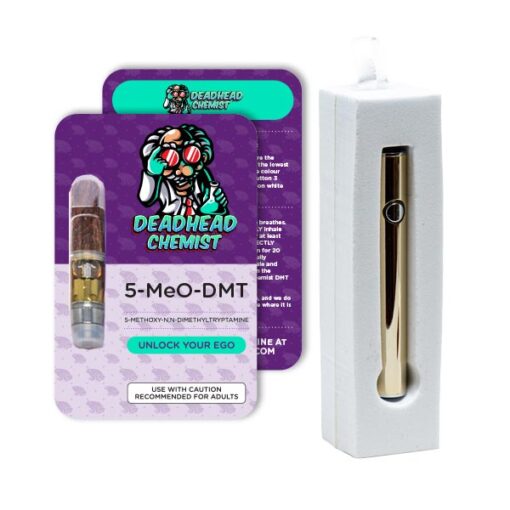

5-MeO-DMT Cartridge 5mL – Psychedelic Vape
$170.00
Key Features
-
Contains 5mL of high-purity 5-MeO-DMT
-
Fits all standard 510-thread vape batteries
-
Extracted and filtered for a clean, reliable experience
-
Vaporizes smoothly without harshness or additives
-
Supports powerful, non-verbal, transcendental states
-
Free from terpenes, preservatives, or carrier oils
-
Packaged securely and shipped discreetly for privacy
The 5-MeO-DMT Cartridge (5mL) provides more than convenience—it offers a direct gateway to the most profound levels of consciousness. Because it combines precision, potency, and purity, it remains the go-to option for those called to explore deep psychological or spiritual terrain. Now available at medicine market, this tool is crafted for those ready to meet the sacred with clarity and intention.
5-MeO-DMT: Neurochemistry, Effects, Research, Risks, and Scientific Context
5-MeO-DMT (5-methoxy-N,N-dimethyltryptamine) is a naturally occurring psychedelic compound belonging to the tryptamine family. It is structurally related to other serotonergic psychedelics such as DMT and psilocybin. Unlike many classical psychedelics that produce visual hallucinations as a dominant effect, 5-MeO-DMT is often described in scientific literature as producing intense alterations in consciousness, perception of self, and cognition.
It has attracted increasing attention in neuroscience and psychology due to its unusually strong and rapid effects on subjective experience, as well as its interaction with serotonin receptors in the brain.
Chemical Structure and Classification
5-MeO-DMT belongs to a group of compounds called tryptamines, which are characterized by a core indole structure similar to the neurotransmitter serotonin.
Tryptamine
Its structural similarity to serotonin allows it to interact with serotonin receptor systems, particularly those involved in mood, perception, and cognition.
Because of this interaction, 5-MeO-DMT is classified as a serotonergic psychedelic compound.
Mechanism of Action in the Brain
The primary mechanism of 5-MeO-DMT involves interaction with serotonin receptors.
Serotonin receptor
Research suggests that 5-MeO-DMT acts primarily as an agonist at certain serotonin receptor subtypes, especially 5-HT2A and 5-HT1A receptors. These receptors are widely distributed in brain regions responsible for perception, emotional processing, and self-referential thinking.
When these receptors are activated, they can temporarily disrupt normal patterns of neural communication, leading to altered states of consciousness.
Effects on Consciousness
Scientific and anecdotal reports describe 5-MeO-DMT as producing extremely rapid and intense changes in subjective experience. These effects typically begin within seconds to minutes when administered through certain routes and may last for a relatively short duration compared to other psychedelics.
Commonly described effects include:
- Altered sense of self
- Distortion of time perception
- Emotional intensification
- Changes in sensory perception
- Dissolution of ego boundaries
- Profound cognitive shifts
Unlike visual-heavy psychedelics such as psilocybin, 5-MeO-DMT is often associated more with internal experiences than external visual imagery.
Ego Dissolution and Psychological Effects
One of the most discussed features in research on 5-MeO-DMT is ego dissolution.
Ego dissolution
Ego dissolution refers to a temporary reduction or loss of the sense of being a separate self. Individuals may report feelings of unity, interconnectedness, or a loss of personal identity boundaries.
This phenomenon is of interest to neuroscientists studying consciousness because it may provide insight into how the brain constructs the sense of “self.”
However, these experiences can be psychologically intense and are not always perceived as positive.
Potential Therapeutic Research Interest
Although research is still in early stages, scientists are investigating whether compounds like 5-MeO-DMT could have therapeutic potential under controlled clinical settings.
Areas of interest include:
- Depression
- Anxiety disorders
- Trauma-related conditions
- Treatment-resistant mood disorders
It is important to emphasize that these investigations are experimental and conducted under strict medical supervision. No standardized medical use has been approved in most countries.
Risks and Safety Concerns
5-MeO-DMT is a powerful psychoactive compound and carries significant risks, particularly outside controlled research environments.
Potential risks include:
- Acute psychological distress
- Confusion or panic reactions
- Elevated heart rate and blood pressure
- Disorientation
- Loss of motor control
- Potential psychological destabilization in vulnerable individuals
Because of the intensity of its effects, it is considered a substance that requires careful clinical oversight in research. contexts.
Legal Status
The legal status of 5-MeO-DMT varies widely across countries. In many jurisdictions, it is classified as a controlled substance.
This means:
- Possession may be illegal
- Distribution may be criminalized
- Research use may require special licensing
Regulations differ significantly, so legal classification depends on local law.
Natural Sources and Occurrence
5-MeO-DMT is found naturally in several plant and animal species. It has also been synthesized in laboratory settings for research purposes.
In nature, it has been identified in certain botanical sources and secretions of some amphibians. However, its natural occurrence does not imply safety or suitability for human use.
Routes of Administration in Research Contexts
In scientific settings, 5-MeO-DMT has been studied using several administration routes, including:
- Vaporization (in controlled research contexts)
- Intranasal administration
- Injection (rare and strictly clinical)
Each method influences onset speed and duration, but all require careful dose control and medical supervision in research environments.
Differences from Other Psychedelics
5-MeO-DMT is often compared with other psychedelics such as psilocybin and DMT.
Key distinctions include:
- Psilocybin: typically longer duration, more visual effects
- DMT: strong visual and geometric hallucinations
- 5-MeO-DMT: stronger emphasis on ego dissolution and non-visual consciousness shifts
These differences are important in neuroscience research on how different compounds affect brain networks.
Neuroimaging and Scientific Studies
Modern neuroscience uses brain imaging techniques to study psychedelics like 5-MeO-DMT.
Researchers examine:
- Changes in brain connectivity
- Alterations in default mode network activity
- Effects on sensory processing regions
The goal is to understand how these compounds temporarily reorganize brain activity and alter conscious experience.
Ethical and Clinical Considerations
Because of its potency, 5-MeO-DMT raises important ethical and clinical questions:
- How to ensure participant safety in studies
- How to manage psychological risks
- How to interpret subjective experiences scientifically
- How to regulate access responsibly
These considerations are central to ongoing psychedelic research.
Conclusion
5-MeO-DMT is a powerful serotonergic psychedelic compound that has attracted scientific interest due to its profound effects on consciousness and brain function. It interacts primarily with serotonin receptors and can produce intense alterations in perception, self-awareness, and cognition.
While early research explores possible therapeutic applications, it remains a highly potent substance with significant psychological and physiological risks, especially outside controlled environments. Scientific understanding of 5-MeO-DMT is still developing, and ongoing studies aim to clarify its mechanisms, safety profile, and potential role in neuroscience and mental health research.
Be the first to review “5-MeO-DMT Cartridge 5mL – Psychedelic Vape”
Related products



VAPE
Reviews
There are no reviews yet.